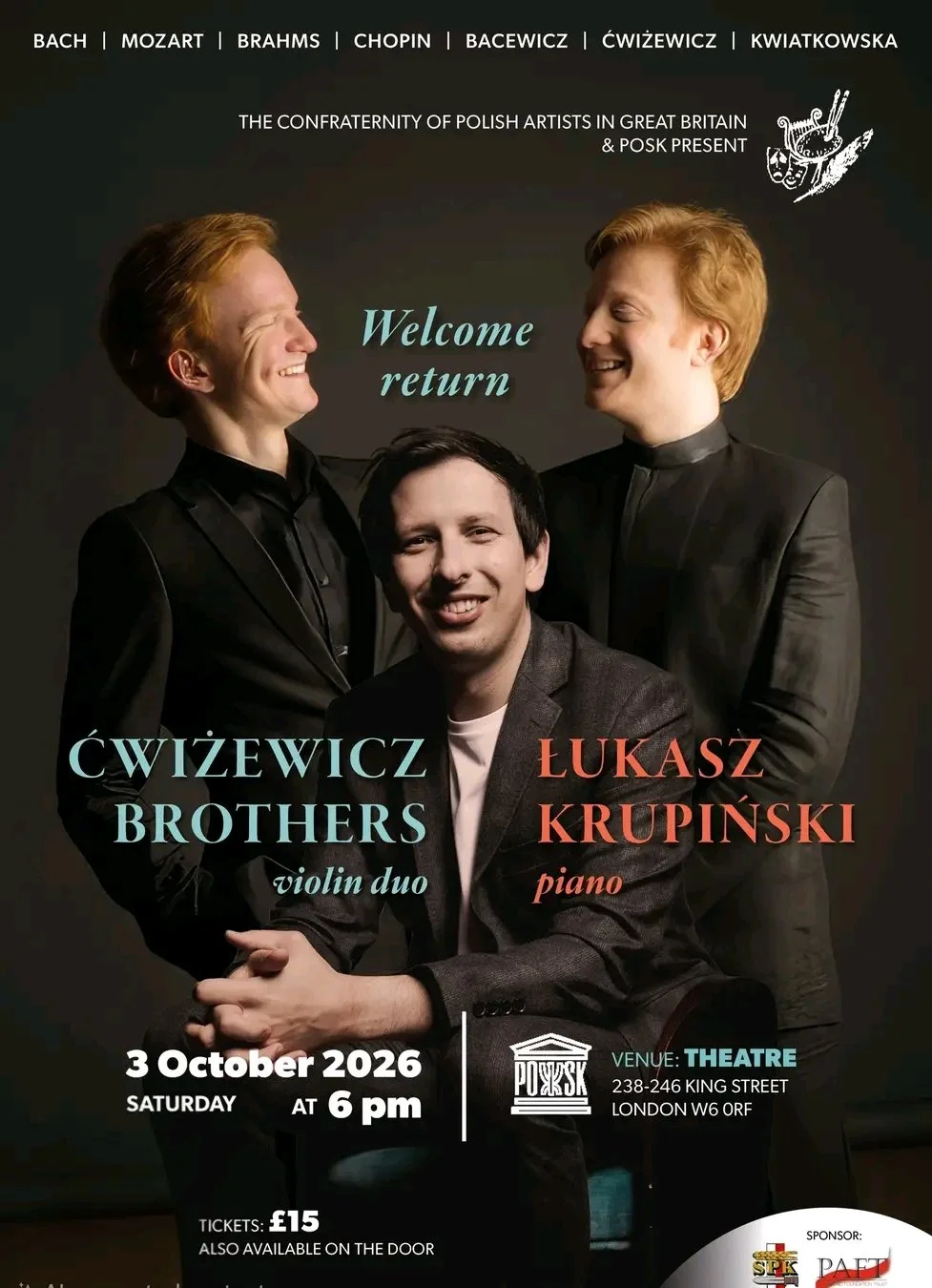
Ćwiżewicz Brothers.
The Ćwiżewicz Brothers bring together the virtuosity of the classical violin repertoire, the folk music of the Carpathian Mountains and an adventurous approach to chamber performance. Moving between two violins and violin and viola, Michał and Filip combine celebrated works with rare discoveries, original arrangements and music written especially for them.
Founded in 2014, the duo grew from a much longer musical partnership. In 1997, thirteen-year-old Michał began teaching his two-year-old brother Filip. Years of informal music-making developed into a performing relationship that combines contrasting musical personalities with an instinctive understanding of one another’s playing.
Their repertoire ranges from Bach and Mozart to the virtuoso writing of Spohr, Wieniawski, Lipiński and Sarasate, and the distinctive sound worlds of Bartók, Prokofiev, Bacewicz and Górecki. Their own arrangements of classical and folk music bring the colours, rhythms and ornamentation of Polish Highland traditions into the concert hall. Alongside recitals, they have performed with piano and as joint soloists with orchestra, with appearances across the UK and in Germany and Poland.
Commissioning new music is an important part of their work. Their commissions include Richard Birchall’s Delirium, premièred in 2016, and Nick Gray’s Quartets for Two Violins and Balinese Gender Wayang, which draws on the brothers’ background in gamelan and explores new instrumental combinations. In 2026, Leamington Music and the Polish Cultural Institute commissioned Daria Dobrochna Kwiatkowska’s Redyk for the brothers’ appearance at the Leamington Music festival.
Their exploration extends beyond the conventional duo recital. In 2015, they premièred a ballet version of Michał’s miniature Tatra Melodies, with original choreography, at the Royal Theatre in Warsaw’s Royal Łazienki. More recently, in Bacewicz’s Quartet for Four Violins, they have become their own quartet partners, performing live alongside recordings of themselves – an approach that opens up music beyond the reach of two players alone.
Recordings - LIVE in concert.
Sergei Prokofiev Sonata for Two Violins op. 56, is perhaps the greatest, most kaleidoscopic work ever written for two violins. Apart from demanding a myriad colours and techniques it creates something less like a duo and more like an orchestral score. Unlike many famous works, inspired by the music of other great composers, it seems this Sonata was actually Prokofiev’s response to a poorly written violin duo by an obscure composer which compelled the young Prokofiev to prove to himself that "it had to be possible to write at least fifteen minutes of good music for this small ensemble!".
Bela Bartok (1881-1945) - 44 Duos for Two Violins, Sz.98, BB 104 (1931)
Bartok travelled extensively through Romania, Hungary and Transylvania collecting the mysterious and angular folk melodies of the local musicians. Here these tunes end up in tiny miniatures, arranged within Bartok's unique style. The suite of six duos selected by Cwizewicz Brothers: Transylvanian Dance; Dance from Máramaros; Bride's Farewell; Hungarian March; Mosquito Dance; Ruthenian Kolomejka.

Michał Ćwiżewicz - Tatra Airs is perhaps the world’s shortest ballet. Written for two violinists and ballerina, this miniature was premiered in its ballet form at the Royal Theatre in Warsaw’s Łazienki in 2015. It’s opening three ‘tunes’ present in bare form the uniquely beautiful ornamented folk music of the Tatra Mountains in southern Poland. This leads directly to the ‘Song of Harnaś’ taken from the closing Act of Szymanowski’s ballet Harnasie op. 55, also based on the same folk music, before finally turning to two fiery dances from the Szymanowski, overlaid one on top of the other, competing for dominance.
Louis Spohr (1784-1859) was a German violinist, conductor and prolific composer. His works straddle the Classical and Romantic periods, and include nine symphonies, thirty-six string quartets and eighteen violin concertos. In addition to his compositions, he invented the violin chinrest and wrote "The Violin School", a treatise on violin playing.
Media.


Repertoire
Daria Dobrochna Kwiatkowska
Redyk, 2026 (commissioned by Leamington Music for Ćwiżewicz Brothers)Karol Lipiński
Trio for two violins and cello in G minor, Op. 8Maurycy Moszkowski
Suite for two violins, Op.71Wolfgang Amadeus Mozart
Sinfonia Concertante for Violin, Viola and Orchestra, K. 364
Duo No. 1 in G major for violin & viola, K. 423
Duo No. 2 in B-flat major for violin & viola, K. 424Sergei Prokofiev
Double Sonata op.56, 1932Pablo de Sarasate
Navarra, Op. 33Louis Spohr
Duo Concertante in D Major, op.67. n.2
Duo Concertante in G minor, op. 67 n. 3Henryk Wieniawski
Études-Caprices, Op. 18
Grażyna Bacewicz
Suite for two violins (1943)
Quartet for four violins (1949)
Johann Sebastian Bach
Concerto for 2 Violins in D minor, BWV 1043Bartók, Béla
44 Duos, Sz. 98, BB 104Birchall, Richard
Delirium, 2016 (commissioned by Ćwiżewicz Brothers)Michał Ćwiżewicz
Tatra Melodies (Wiązanka Podhalańska) 2013Ernst von Dohnányi
Serenade in C major for string trio, Op. 10Henryk Górecki
Sonata for Two Violins, Op.10, 1961Nick Gray
Quartets for Two Violins and Balinese Gender WayangJohan Halvorsen
Passacaglia for Violin and Viola (1893)Fritz Kreisler
Liebesleid arr. Ćwiżewicz Brothers